Feedzilla

Saturday, June 6, 2020

Pakistan, China discuss cooperation in judiciary


By Masood Sattar Khan
(Pakistan News & Features Services)

China appreciated the Pakistan superior Court’s active commitment to China-Pakistan friendly cooperation, expressing its willing to strengthen exchanges and mutual learning in the judicial field with Pakistan to make more efforts for the development of bilateral relations.

These sentiments were expressed by the Chinese Ambassador in Pakistan, Yao Jing, during his meeting with the Chief Justice of Pakistan, Mr Justice Gulzar Ahmed, at Islamabad. 

 Ambassador Yao highlighted China-Pakistan anti-epidemic cooperation and the latest developments in the bilateral relations, emphasizing that China and Pakistan are all-weather strategic cooperative partners. 

“China has always attached great importance to relations with Pakistan and is willing to continue work with Pakistan to jointly cope with the challenges of the epidemic and actively promote the construction of China-Pakistan Economic Corridor (CPEC),” the Chinese diplomat stated. 

He emphasized on cooperation in the areas of society and people's livelihood, and work together to maintain regional peace and stability. 

According to the information shared by the Chinese embassy in Islamabad, CJP Mr. Justice Gulzar Ahmed reciprocated similar sentiments, having remarked that China and Pakistan were traditional friendly neighbours and the relationship between the two countries had stood the test of time.

It was pointed out that the successive governments of Pakistan have firmly promoted cooperation with China, and friendship with China remained deeply rooted in the hearts of the Pakistani people. 

“The Supreme Court of Pakistan actively supports the development of China-Pakistan relations, and is willing to strengthen exchanges and cooperation in the judicial field with China to jointly make due contributions to China-Pakistan relations and the construction of the Belt and Road Initiative (BRI),” the CJP was quoted as saying.

Coronavirus Update: Highest single-day death toll in Sindh

By Mukhtar Alam
(Pakistan News & Features Services)


Karachi’s intensive care hospital beds were reported filled with critically ill COVID-19 patients on June 5, as the provincial health authorities registered yet another 1,353 new cases, with 40 related deaths, an all days’ highest toll, across the province. Earlier, Sindh had reported a maximum of 38 deaths on May 30. 

Officially on June 5, it was learnt that as many as 129 patients, including 81 off ventilator patients, were under treatment at 10 public and private health facilities in Karachi, in addition to 196 those who were occupying beds in high dependency beds at 11 hospitals, out of a total 374 reserved for COVID-19 patients.

ICU beds were vacant at the Aga Khan University Hospital (6 beds), National Institute of Child Health (2) and Ziauddin Hospital North Nazimabad (one). 

Literally, two of the hospitals reserved for COVID-19 patients in Karachi conceded on June 5 that they were not in a position to accept new coronavirus patients as they had run short of beds. 

The Sindh Chief Minister, Syed Murad Ali Shah, in his routine daily message related to COVID-19, shared that at present 370 patients were in critical condition, including 62 on ventilators. 

According to Sindh health department summary released on June 5, the latest 40 deaths pushed the COVID-19 tally to 615, which constituted about 33% of the total deaths (1,878) having occurred in the country. Sindh’s case fatality rate came as 1.7%.

As many as 30 patients lost their lives in Karachi, including one out of Karachi resident, while two persons each perished at Shikarpur, Khairpur, Kashmore and Jacobabad. Hyderabad and Kambar Shahdadkot reported a death each. 

However, the COVID-19 daily summary did not mention ages of people succumbing to the lethal virus, in contrary to its norms. 

To many media persons covering coronavirus authorities’ long prevailing practice of not disclosing the names of hospitals, where the patients died, remained a matter of concern also. 

The new infections, according to health department, were reported from Karachi (1,089), Hyderabad (63), Ghotki (42), Khairpur (28), Sukkur (27), Jacobabad (17), Larkana (13), Mirpurkhas (12), Sanghar (11), Umerkot (6), Tando Mohammad Khan (6), Kashmore (6), Umerkot (6), Naushero Feroze (3), Dadu (3), Shikarpur (2), Jamshoro (2), Shaheed Benazirabad (1), Thatta (1), Sujawal (1) and Tando Allahyar (1). 

According to official sources, overall 15 testing centres conducted a total of 7,377 tests, against a cumulative capacity of 8,650 tests. 

All the laboratories with the exception of Hashmanis, DUHS Ojha and Ziuddin Hospital conducted tests below their respective determined capacities. 

The sources further revealed that 20 patients whose deaths were confirmed on June 4 included three patients dying off ventilators; two died at home, while another one was not clinically indicated or advised by doctors. Sindh tested 215,860 samples so far, out of which 34,889 were found positive for COVID-19.

In the meantime, it was learnt that of the 615 deaths Sindh reported over 110 died at homes. As many as 69 patients have died at JPMC, 67 at DUHS, 60 at SIUT, 57 at AKUH, 51 at Indus Hospital, 48 at CHK, 36 at Ziauddin Hospital, 15 at PNS Shifa, 14 at LUMHS Hyderabad and Lyari General Hospital (10). 

Meanwhile, a team from Islamabad including Dr Faisal Sultan, Prime Minister’s focal person on COVID-19 and Brig Ali Adil, Chief of Staff of National Command and Operation Centre, visited the Civil Hospital Karachi on June 4 to obtain first hand insight of Karachi’s healthcare capacity and fostering enhanced cooperation and coordination with NCOC. 

Senior officers led by Medical Superintendent, Dr Khadim H Quraishi, apprised the team about the coronavirus treatment related intensive care facilities available at the hospital, a source informed.

Chinese youngster promoting rice research in Pakistan


By Masood Sattar Khan
(Pakistan News & Features Services)

A Chinese young man, Dai Yingnan, has devoted three years to promoting rice production in Pakistan. 

Dai Yingnan, in a media talk, disclosed that his aim was introducing high-yield hybrid rice and advanced agriculture technology. 

“These efforts of mine will definitely improve rice production as well as alleviate the financial sufferings of farmers,” he reckoned. 

Born in a village of Liaoning Province in northeast China, the post-90s young man had personal experience of growing corn and rice with his parents when he was a kid and therefore had a deep understanding of the hardship of farmers. 

“I chose to learn agronomy at Hunan Agriculture University at the advice of my teacher. After graduation in 2017, I got an offer from Yuan Longping High-tech Agriculture Company and was later assigned to Pakistan to promote hybrid rice,” he revealed. 

“Carrying out research and promoting the plantation of hybrid rice in Pakistan is never an easy job. I had to select one type of seed that is most suitable for the local environment out of thousands of seeds,” he added. 

The temperature in Pakistan during summer can touch down to even 50 degrees centigrade and it’s accompanied with fierce sunlight and strong dust. While walking in rice fields, anyone could be sweating and uncomfortable. 

Since April 2018, Dai began to make short videos to record his life and work in Pakistan and posted them on Chinese websites.
In October, the harvest month every year, the yield of hybrid rice is apparently higher than the locally grown rice, and even twice in some places by comparison.

“I used to invite local farmers to share the joy of harvest when we reap the hybrid rice because I have a feeling of accomplishment when I see smiles on their faces,” a beaming Dai observed.

Bald men more prone to COVID-19: Study


By Masood Sattar Khan
(Pakistan News & Features Services) 

Bald men may be at higher risk of suffering from severe COVID-19 symptoms, emerging evidence has suggested. 

The link is so strong that some researchers are suggesting baldness should be considered a risk factor called the ‘Gabrin sign’ after the first US physician to die of Covid-19 in the United States, Dr Frank Gabrin, who was bald, The Telegraph reported.

"We really think that baldness is a perfect predictor of severity," the lead author of the key study professor Carlos Wambier of Brown University, told the newspaper. 

The data since the beginning of the outbreak in Wuhan, China, in January has shown that men are more likely to die after getting coronavirus. 

In the UK, a report this week from Public Health England found that working-age males were twice as likely as females to die after being diagnosed with COVID-19. 

In a study, 79 percent of the men suffering with COVID-19 in three Madrid hospitals were bald. The study of 122 patients, published in the Journal of the American Academy of Dermatology, followed an earlier piece of work among 41 patients in Spanish hospitals, which found 71 percent were bald. 

The background rate of baldness in white men of a similar age to the patients studied was between 31-53 percent. Other scientists said that more work needed to be done but were excited by the potential link.

Dr Imran Ali Shah demands COVID-19 tests for 24 hours, residence for doctors near hospital

Pakistan News & Features Services

Legislator Dr Syed Imran Ali Shah has advised the government of Sindh to establish mobile testing units and a hospital, designated for COVID-19 patients, in every district of the province. 

One of the leading orthopedic surgeons of the country, he has demanded the COVID-19 tests to be conducted round the clock all over the province instead of doing it during specific times of 8 am to 8 pm. 

Speaking during the session of the Sindh Assembly, Dr Imran Ali Shah regretted that 250 doctors, working in different shifts at the Dr Ruth K.M. Pfau Civil Hospital Karachi, have had to return to their respective homes after treating COVID-19 patience in the absence of having no separate accommodation. 

The parliamentarian from Karachi urged the provincial government to arrange accommodation for the doctors in the vicinity of the hospital so that their families were not unnecessarily exposed to the virus.

Friday, June 5, 2020

Global research institutes join hands for new pandemic study


By Abdul Qadir Qureshi
(Pakistan News & Features Services) 

A new grant that seeks to spur vital global research into infectious diseases and pandemics has been awarded to the University of Washington (UW) and its partners, including the Aga Khan University (AKU), by the U.S. National Institutes of Health’s Centers for Research in Emerging Infectious Diseases (CREID). 

The US $8.75 million grant spread over five years will help support UW and collaborators at Rockefeller University in New York City and institutions in Brazil, Pakistan, Senegal, South Africa and Taiwan to develop the United World for Antiviral Research Network (UWARN). 

Such large-scale global collaborations are becoming all the more necessary to combat diseases, known and unknown. Just two years ago, in 2018, the World Health Organization (WHO) had identified a priority list of viruses for which no vaccines and drugs were available. 

It included Disease X, a stand-in for pathogens yet unknown that could cause a serious international epidemic-COVID-19 is exactly the type of threat that Disease X was meant to represent. 

The UWARN will help in the race to identify potential pandemic viruses, develop the urgently needed diagnostic tools and drugs that work against a range of pathogens, and expand understanding of the body’s immune responses to viruses which is key to vaccine development. 

Dr Wesley C. Van Voorhis, co-director of UW’s Center for Emerging and Reemerging Infectious Disease, CERID, and one of the initiative’s principal investigators, spoke of how exciting it was to establish UWARN. 

“We are particularly excited to be collaborating with Aga Khan University with its excellent research personnel and infrastructure, plus its outstanding connections in Africa through its medical school in Kenya,” Dr Voohis said. 

“Pandemics are becoming an increasingly frequent threat to public health in the developing and developing world. We need to deepen our understanding of emerging infectious diseases in order to prevent the emergence of new viruses from becoming pandemics that threaten our way of life,” Professor Asad Ali, associate dean for research at Aga Khan University, remarked. 

The UWARN researchers will be looking to advance innovative approaches to laboratory diagnosis, including identifying reagents for antibody tests that detect antibodies in the blood in order to diagnose an active or previous infection. 

Another approach would be through ‘designed proteins’ that release light when antibodies are present in the blood, using technology developed by UW Medicine Institute for Protein Design. 

The group will also work to improve understanding of how viruses manipulate the human immune system, facilitating development of better blood biomarkers to predict the severity of diseases as well as drugs that could improve outcomes for patients with viral infections. 

Several AKU faculty will be involved: Najeeha Talat Iqbal, from the paediatrics and child health and biological and biomedical sciences is the principal investigator for Pakistan. Dr Farah Qamar and Dr Ali Faisal from paediatrics and child health, and Professor Erum Khan from pathology and laboratory medicine are co-investigators on the project. 

The UWARN will serve as one of ten centers in the CREID Network which has multidisciplinary teams of investigators spread over 30 countries. The CREID network will be coordinated by the Research Triangle Institute, a large non-profit research organisation with regional and project offices in over 75 countries, and Duke University known for its cutting-edge medical research and home to the Duke Human Vaccine Institute.

Coronavirus Update: Another 1,667 infected in Sindh

By Mukhtar Alam
(Pakistan News & Features Services)


Sindh registered 1,667 new COVID-19 infections, with 20 related deaths, on June 4, as the designated COVID-19 laboratories across Sindh were reported endeavoring for conducting the tests matching to their pre-determined daily maximum capacity. 

The Sindh Chief Minister, Syed Murad Ali Shah, in his statement on COVID-19 disease situation, revealed that the provincial government had increased the testing capacity to 8,390 tests per day and laboratories cumulatively conducted the tests equal to their total capacity during the last 24 hours, ending at 9 am on June 4.

According to the chief minister, as many as 1,667 persons were found positive for the lethal virus, which has continued haunting the people and the healthcare units as well as the government functionaries for last 100 days. 

He once again appealed to the masses to exercise more caution as COVID-19 cases were on the rise. “People should not go out of home without wearing the face mask.” 

Some researches, in the meantime, suggested that there were 20 laboratories across the province, which have been designated by authorities for conducting the coronavirus tests. 

These laboratories or testing units included 15 located at Karachi, while another two at Hyderabad, two at Sukkur and one at Larkana, which gradually increased their testing capacity up to a combined total of 8,650.

A source revealed that these laboratories collectively performed 8,390 tests during the last 24 hours, with at least four which did not take any single test. 

“There were seven laboratories which conducted tests beyond their fixed number while another seven performed much below their capacity.” 

As of June 4, as per an official summary, DUHS Ojha facility, among the laboratories, conducted 378 tests, with a positive percentage of 45, followed by, Indus Hospital (41%), AKUH (40%), SIUT (39%), GMMC Sukkur (37%), CHK (36%), Chughtai Lab (36%). The overall positive rate remained 29%.

Another source claimed that efforts were being made to attain a 100% conducting of the laboratories. 

"As many as 20 AKUH sites have been linked with every tehsil across the province, while 16 LUHMS sites have been linked with district headquarters." 

It was further learnt that sampling teams were also being enhanced at ground level but supply of sample extraction kits was still an issue. 

According to official data, the new infections reported on June 4 included 1,311 from Karachi, followed by Hyderabad (42), Ghotki (38), Kashmore (32), Khairpur (25), Sukkur (24), Larkana (22), Shaheed Benazirabad (21), Dadu (11), Sujawal (10), Badin (8), Jamshoro (7), Sanghar (5), Jacobabad (3), Tando Mohammad Khan (3), Umerkot (3), Matiari (1), Mirpurkhas (1) and Thatta (1). 

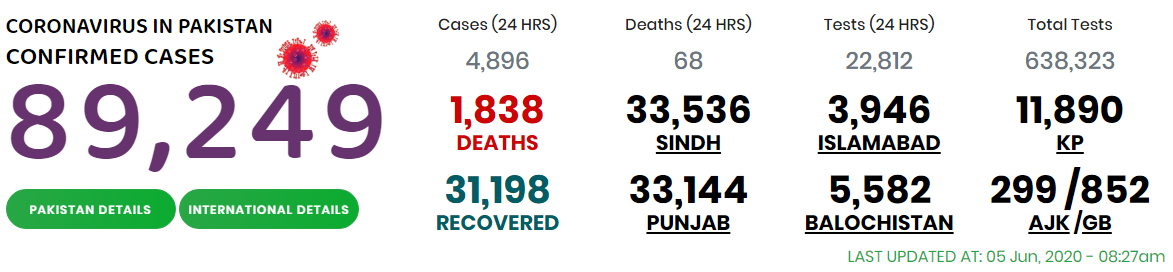
As of June 4, the ratio of women patients in the total 33,536 positive tests was found to be 28.3%. 

In the meantime, 764 patients were sent home after being cured, taking the tally of patients recovering from coronavirus disease to 16,782, while 1,170 were still admitted at different hospitals across the province, out of which 366 were told to be in critical condition and 66 of them were on ventilators.

It was gathered that bed occupancy rates have changed in the ICU and HDU units and isolation wards of different hospitals. 

The details of patients passing away because of COVID-19 could not be known once again as neither the Chief Minister provided the details of the 20 patients, who lost their lives in the province due to the diseases, nor the provincial health department released any summary or district-wise breakdown of deceased persons on June 4. “Including 20 patients who died during the last 24 hours, the death toll has increased to 575,” Chief Minister in his message said.

Pakistan business to benefit as China loosens restriction on international flights


By Masood Sattar Khan
(Pakistan News & Features Services)

After successfully reining in COVID-19, China has taken another bold step by announcing lowering restrictions on international flights. 

China has announced that from June 8 it has decided to lower restrictions on international flights, People’s Daily reported. 

A maximum of 64 international flights are expected to arrive in China after country lower the restriction, the paper reckoned. 

With the announcement of loosening restriction on international flights, the country has estimated 4,700 to 5,000 passengers to arrive in the country from around the world, the newspaper reported quoting China’s Civil Administration regulators. 

The announcement also brought a sigh of relief for a number of Pakistanis that after launch of many projects under the China Pakistan Economic Corridor (CPEC), there were hectic business activities and nationals from both sides were frequently travelling each other’s country. 

A number of business community members from Pakistani intended to visit China to meet their counterparts, but due to suspension of flights, they could not proceed there. After this announcement they hoped to fly China and resume their business activities soon. 

As elsewhere around the world, on spreading of deadly Coronavirus (Covid-19) pandemic, all kind of flights had been suspended except the chartered flights carrying aid/assistance.

Approval of ML-1, other projects deferred


By Masood Sattar Khan
(Pakistan News & Features Services)

The Central Development Working Party (CDWP) has deferred approval of 10 projects, on the agenda, including ML-I. 

The approval of 10 projects, including ML-I, and concept clearance of three projects was deferred till June 5, Gwadar Pro official tweeted.

The approval of projects has been deferred because of time constraints as agenda was consisted of 21 items, it further reported. 

According to the CPEC website, the scope of the project was to double entire track from Karachi to Peshawar, speed of passenger trains to be raised from 65/110 km/h to 160 km/h, freight trains to operate at 120 km/h, computer based signaling and control system and grade separation to ensure safety of train operations. 

The ML-1 starts from Karachi and goes to Peshawar via Hyderabad, Nawabshah, Rohri, Rahim Yar Khan, Bahawalpur, Khanewal, Sahiwal, Lahore, Gujranwala and Rawalpindi.

World Environment Day 2020 assumes greater significance amid COVID-19

By Abdul Qadir Qureshi
(Pakistan News & Features Services)

“COVID-19 has brought all possible challenges to humans but the single most is the threat to life with hundreds of thousands already succumbed to this epidemic and yet it is not under human control. The lockdown has however resulted in lower pollution and reduced climate change adverse impact.” 

This was stated by Senator Nisar Memon, a former federal minister, in his message on the occasion of the World Environment Day 2020 falling on June 5. 

“The ‘Environment Day’ has been celebrated all over the world on June 5 in an effort to create awareness and ensure actions are in place for the protection of the environment. It had started way back in 1972 by the United Nations,” he recalled. 

“Each year there is a theme based on challenges we face. This year 2020 theme for the day is ‘Time for Nature’. It is most appropriate since there is a great challenge to biodiversity,” he reckoned. “It is time to mold our lives closer to nature by protecting, preserving and promoting healthy living. This can be achieved by focus on providing the essential infrastructure that supports life on Earth and human development,” the Senator thought. 

“In Pakistan, over 60% of population lives in rural areas which are ignored for all these years. The essential infrastructure for education, health and social delivery must assume priority in upcoming budget and all policies must be endorsed by people’s representatives in the assemblies and senate,” he advised. 

“For improving biodiversity and environment, we must reduce pollution and implement water and environment policies developed in the last 20 years by various governments, free mountains from human interventions, let rivers flow without creating obstacles in the river path, refrain from discharging chemicals in river and sea without first treating them of toxicity, reduce use of fertilizer by growing organic food, grow and not cut trees, provide alternate fuel to rural areas, use natural solar and wind power, protect marine life and coastal areas rich in fish for sustainability of life,” the former federal minister explained. 

“We, as country, are committed to implementing 17 U.N. Sustainable Development Goals (SDG) and many of them relate to environment but specifically SDG 13 relates to climate actions, SDG 14 about life below water, SDG 15 life on land and SDG 9 for innovation and infrastructure,” he reminded. 

“The Articles 31 and 32 of our Constitution protect right to life as a fundamental right. It encompasses, the protection and preservation of environment, ecological balance free from pollution of air and water and sanitation. The Supreme Court in one of its judgements has held that the right to clean environment is a fundamental right of all citizens of Pakistan covered by the “right to life” and the “right to dignity” under Article 9 and 14 of the Constitution,” Senator Nisar Memon pointed out. 

“But above all, the Quran guides us in Surah 31 all about the environment created for the benefit of mankind and commands us not to be wasteful or extravagant, not to disrupt the balance that exists in nature and not to change the creation of God. Water is a huge life-providing theme in the Quran. It enlightens us about how He creates life through water then sustains it by streams, the rains, rivers and oceans that are homes for so many creatures. We should also be guided by Surah 2:60: Eat and drink from the provision of Allah, and do not commit abuse on the earth, spreading corruption,” he added. 

“Let today be the day of true commitment to protect environment for the sake of our future generation and also follow the Constitution and the Quran,” he concluded.