Feedzilla

Sunday, July 19, 2020

China's port city Tianjin houses beautiful mosque


By Masood Sattar Khan
(Pakistan News & Features Services)

Tianjin, one the China’s busiest port cities and close to Beijing, has a beautiful masque sprawling on 1970 meters with all modern facilities for worshippers. 

The famous Tianjin East Mosque is located in downtown at Ermalu Road in Nankai district. Tianjin is estimated to have around a Muslim population of 180,000. 

The mosque was built anew in 2008 when it was relocated to shift for more spacious space to facilitate the local Muslims. 

The new mosque is very beautiful with modern facilities thus the atmosphere becomes more comfortable for the worshippers. The walls of the main prayer hall are decorated with verses from Holy Quran.

China frenzy moviegoers’ wait end


By Masood Sattar Khan
(Pakistan News & Features Services) 

China's frenzy moviegoers, denied the pleasure of watching their favourite movies due to the COVID-19 pandemic, don’t have to wait further as cinema houses are scheduled for reopening on July 20. There was a big rush as box office pre-sales for the day have surpassed 256,000 yuan ($36,700) as of afternoon on July 19.

According to the Maoyan Pro app which observes real-time box office information, pre-sales for cinemas across the Chinese mainland had exceeded 256,000 Yuan as of 3:00 pm and was going up rapidly. 

According to the app, a cinema called Chengdu Eying 1958 Movie Palace in Southwest China's Sichuan Province championed with 12,000 Yuan in box office pre-sales on July 19, with 589 viewers having booked their tickets. 

Altogether 12 screenings have been scheduled at Eying 1958 cinema and the only film that will be shown is A First Farewell, a movie produced in Northwest China's Xinjiang Uyghur Autonomous Region that tells the story of a local Xinjiang boy getting along with his friends and mother.

The top 10 cinemas with the largest presale bookings were mainly located in southern China, such as Hangzhou, Shanghai, Guangzhou and eastern China's Jiangsu and Anhui provinces. 

The China Film Administration announced on July 16 that cinemas in low-risk areas will be allowed to reopen starting from July 20, while those in high-risk areas will still remain closed. 

In order to ensure safety of the moviegoers, cinemas that reopen must strictly implement epidemic-related safety measures such as wearing of face masks, limiting seating capacity for each showing (no more than 30 percent), reducing the number of films to half that of the pre-epidemic period and banning all food and beverages in theaters, according to the announcement. 

Moviegoers must occupy alternate seats with a space of at least one meter between one another. The policy also requires that intervals between showings will be extended, for thorough cleaning and disinfection in between.

Coronavirus Update: Interventional gaps in management of patients feared

By Mukhtar Alam
(Pakistan News & Features Services)


Amidst reports that daily COVID-19 infection number was on decline, any significant reduction in the number of critically ill patients at distinguished hospitals of Sindh, however, could not be witnessed till July 18 when the authorities in the government confirmed 71% critically ills, among the 744 hospital-patients, with registration of 880 new infections and 22 related fatalities during the last 24 hours.

As of July 17, there were 57,886 active cases in the country, out of which 2,690 cases were hospitalized, including 1,604 (59.62%) in critical condition, against Sindh’s 419 in critical condition. 

A study of relevant COVID-19 data revealed that Sindh had an average of 1,013 COVID-19 patients hospitalized daily during one-week period (July 12 to 18), out of which 51 per cent were reported critically ill. About 16% of the critically ill patients were put on ventilators daily. 

According to official reports, 72 patients occupying intensive care unit beds were put on ventilators in various hospitals of Karachi on July 18, against 77 using ventilators on July 17. 

As of July 17, the Karachi hospitals were having 116 patients on low flow oxygen and 188 on high flow oxygen while 96 were put on ventilators. Hyderabad had 11 on low flow oxygen, 10 on high flow oxygen while no one was put on ventilators. 

Keen observers noted that the presence of critically ill patients in high number reflected on the performance of hospitals. They feared that there are some interventional gaps in the management of COVID-19 patients, which finally led to an extraordinary increase in the number of patients requiring intensive care support and mechanical ventilation, many of whom failed to survive the diseases despite prolonged hospitalization. 

An official report said that the deceased COVID-19 patients belonged to all age groups, including females. Overall 1,502 patients have died at about 40 public and private hospitals across the province, so far. 

Of the patients admitted, 207 lost their lives at JPMC, 204 at DUHS Hospital, 201 at CHK, 158 at SIUT, 152 at Indus Hospital Korangi, 113 at AKUH, 86 at the Karachi Trauma Centre, 76 at ZU Hospital Clifton, 59 at Lyari General Hospital, 51 at ZU Hospital North Nazimabad, 33 at LUMHS Hospital Hyderabad, 23 at LNK Karachi, among others.

The Sindh Chief Minister, Syed Murad Ali Shah, in his daily statement related to COVID-19 status on July 18, informed that there were 18,761 infected people, who were receiving treatment at homes or isolation centres and hospitals across the province.

“We have 744 patients at hospitals, out of which 526 are in critical condition, while 72 required ventilators,” he added.

He further said that with 22 more COVID fatalities were reported during the last 24 hours ending July 18 morning, pushing the overall number of deceased persons to 1,974.

However, neither the Chief Minister nor the health department elaborated the fatalities in terms of their age and hospital or home and district they lived in.

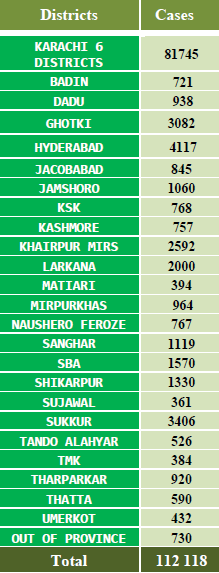
According to the Chief Minister’s statement, Karachi reported 267 new cases, followed by Hyderabad (67), Khairpur (42), Sanghar (37), Sukkur (31), Shaheed Benazirabad (28), Mirpurkhas (27), Sujawal (22), Ghotki (21), Naushero Feroze (20), Dadu (18), Badin (15), Kambar Shahdadkot (13), Kashmore (13), Tando Allahyar (13), Larkana (12), Shikarpur (11), Jacobabad (7), Matiari (7), Thatta (7), Jamshoro (6), Tando Mohammad Khan (6) and Umerkot (2).

On July 17, all the COVID-19 testing laboratories, except one private and three public sector laboratories performed. Collectively they examined 9,270 samples, out of which 1,182 were found positive, including 880 new confirmed cases. The percentage of new cases among the samples came as nine.

Sindh has reported a total 112,118 cases so far, while 91,383 of them have recovered from the disease.

Focus on agriculture, industrial development in CPEC 2nd phase


By Masood Sattar Khan
(Pakistan News & Features Services)

The second phase of the China Pakistan Economic Corridor (CPEC) will focus development of agriculture and setting-up industrial zones. 

The Federal Minister of Science and Technology, Fawad Chaudhry, in an interview on July 18, disclosed that energy and infrastructure development projects amounting to US$46 billion were undertaken in the first phase of the CPEC. 

Giving breakup of these invested amounts, Fawad Chaudhry pointed out an amount of $34 to 35 billion was spent in energy projects and remaining amount on construction of highways. 

Now the second phase of CPEC, being taken up under which Special Economic Zones will be set up around the infrastructure built under the first phase where factories would be established and finished goods will be exported. 

"The government has added agriculture in the CPEC second phase. I request Chinese companies to come forward and make investment along with local partners in Pakistan,” he emphasized. 

He assured whatever facilities the Chinese investors are availing in their own county, the same Pakistan will be provided.

China supports Afghanistan’s inclusion in CPEC


By Masood Sattar Khan
(Pakistan News & Features Services) 

China supports extension of the China-Pakistan Economic Corridor (CPEC) to Afghanistan so that the Afghan people can benefit from the Belt and Road Initiative (BRI).

This was disclosed by the Chinese Foreign Ministry’s spokesperson Hua Chunying a regular media briefing in Beijing. 

“China appreciates the resumption of trade between Pakistan and Afghanistan and ensure to play a constructive role to promote economic development and integration between two countries,” she remarked. 

Hua Chunying pointed out that Gwadar and other CPEC projects have played a significant role in regional integration. 

She mentioned that Pakistan has opened five key routes with Afghanistan for bilateral and transit trade over the past weeks to help war-ravaged Afghanistan boost trade. Pakistan, it may be recalled, had closed all trade routes with Afghanistan in March due to the COVID-19 outbreak.

CPEC brings employment opportunities for locals in Gwadar


By Masood Sattar Khan
(Pakistan News & Features Services)

The working classes, particularly labourers, living in Balochistan, who in the past happened to earn bread and butter for their families in other provinces, are now enjoying the luxury of jobs in their own province thanks to the projects initiated under the China Pakistan Economic Corridor (CPEC). 

According to the available details, as many as 280 or 94 percent locals persons were working at the Gwadar port alone, while on Gwadar bay Eastway there are 697 or 98 percent local people engaged. 

The CPEC projects have been recognized as the game-changer for Pakistan economy and the generation of jobs for locals was one of its major benefits.

Friday, July 17, 2020

Fiber optic deal to revolutionize digital communication


By Masood Sattar Khan
(Pakistan News & Features Services)

The $44 million China-Pakistan fiber optic that one cluster was operationalized recently will revolutionize digital communication.  
The 820-km long fiber optic from Khunjerab China to Islamabad was operationalized on July 12. In the next phase it will connect with Karachi and then Gwadar. 

After the launch of a number of mega projects under CPEC, the digital communication between Pakistan and China has increased manifolds. 

Also a large number of Pakistani students are getting higher education in different universities in China. Recently these students were attending their classes online as their classes were suspended because of COVID-19. These students needed a fast and reliable internet facility to pursue their studies. As per plan the network will also be connected with Transit-Europe-Asia Terrestrial Cable network.

Coronavirus Update: Sindh's patient recovery rate inching towards 70%

By Mukhtar Alam
(Pakistan News & Features Services)


Sindh, which in recent days has been reportedly witnessing calm in its daily new COVID-19 infection rates, again registered a significant increase in the number patients who recovered from the disease on July 16 when authorities in the government confirmed 1,155 new cases, with 34 more related fatalities.

On July 16, according to official data, another 3,775 patients got recovered, while 4,872 patients were reported ‘recovered’ against a daily infection number of 1,140 on July 15, 1,591 recovered against the new infection number of 1,151 on July 14 and 1,871 recovered against the infection number of 1,089 on July 13.

The Sindh Chief Minister, Syed Murad Ali Shah, in his routine coronavirus status statement on July 16, said that there were 34,070 active cases, all under medical supervision at hospitals or homes, while 74,076 patients had been cured or discharged from health facilities.

He further said that 923 COVID-19 infected patients were receiving treatment at hospitals, including 375 in critical condition, while 105 were put on ventilators across the province. As of July 16, Sindh’s overall recovery rate was 67%, against the overall infection rate of 18%.

Keen observers said that the recovery of infected patients was encouraging and Sindh needed not only to contain its existing level of new daily infections but also to ensure the recovery rate continued to improve steadily.

As per the new infection data, Karachi contributed 417 (36%) new cases to the total cases reported across the province during the last 24 hours ending on July 16 morning.

In terms of new infection reporting, Karachi was followed by Shaheed Benazirabad (53), Khairpur (49), Ghotki (41), Larkana (40), Sukkur (38), Naushero Feroze (37), Hyderabad (33), Jacobabad (29), Thatta (21), Badin (19), Sanghar (18), Kambar Shadadkot (17), Shikarpur (16), Jamshoro (15), Dadu (14), Kashmore (14), Mirpurkhas (13), Sujawal (10), Umerkot (5) and Tando Mohammad Khan (1), as per the Chief Minister’s statement, which did not provide the details of patients who succumbed to COVID-19 either at hospitals or homes. He disclosed that the overall tally of deaths had reached to 1,922.

The Sindh health department also did not release any district wise details of the fatalities or the daily COVID-19 summary on July 16, but a website hosted by the department updated the number of fatalities as 1,960.

In the meantime, according to a WHO Sindh sub-office report, updated on July15, said that 11,660 tests were conducted during the preceding 24 hours in the province, out of which 6,662 were from Karachi, with 12% positive cases, 4,264 from Hyderabad, with 13% positive cases, 116 in Sukkur, with 11% positive cases, while 18 tests were performed in Larkana, none tested positive.

The report further said that of the 370 intensive care unit beds available at various Karachi hospitals, 27% of them was occupied by patients availing ventilators, while another 39 went to off-ventilator patients and 34% beds were vacant. Coming on the healthcare workers infected with COVID-19 in Sindh so far, the report said that 77% of them were doctors.

Study finds fear of contracting COVID-19 major source of anxiety, stress


By Mukhtar Alam
(Pakistan News & Features Services)

A group of researchers at the Aga Khan University (AKU), having conducted a study, has found fear of contracting COVID-19 as the major source of anxiety and stress among respondents they surveyed online. 

“Three out of four Pakistani adults are suffering from moderate or high levels of stress during this COVID-19 pandemic while nearly one in three are experiencing moderate or severe anxiety,” the researchers reported while releasing findings of their first phase of an ongoing survey. 

Over 90 per cent of the participants were from Sindh and Punjab, having been contacted by the Karachi based researchers of the university. 

As many as 374 respondents were reached to determine if people had generalised anxiety disorder, perceived stress or both conditions.

“The respondents ranked the top three causes of anxiety and stress as being fear of contracting the virus, financial losses during the pandemic and losing a loved one to COVID-19,” a communication issued by the AKU said.

According to the research group hailing from AKU’s department of community health sciences (CHS), 76% of the survey participants were much more concerned about their loved ones catching the disease. In comparison, four of 10 respondents reported a lot of fear or extreme fear about catching the virus themselves.

Professor Sameen Siddiqi, the CHS department chair commented that the pandemic had exposed the social and economic vulnerabilities and created widespread uncertainty in society.

“If left unchecked, stress associated with COVID-19 can lead to distress and the distress can lead to disease,” it was warned.

The study also found a high correlation between exposure to rumours via WhatsApp and anxiety or stress, since more than eight out of ten respondents suffering from the two conditions were using this social media platform.

Thursday, July 16, 2020

Major steps being taken for food security


By Masood Sattar Khan
(Pakistan News & Features Services) 

The government is taking every possible measure to ensure food security and staple products reach the masses at affordable prices. It is exploring all avenues to ensure food is available at accessible in every nook and corner of the country.

In this connection, the Federal Minister of Science and Technology, Fawad Chaudhary, has announced launching of a fleet of Agriculture Drone by a private entity that would be used to stemming locust from orchards and agriculture fields but with the installation of latest technology the drones' sensor can identify only the clusters where insecticide spray is required. These measures would definitely help protect crops from different insects. 

The Minister also recently held a meeting with the Chairman CPEC Authority, Lt Gen Asim Saleem Bajwa, and discussed coordinated steps under CPEC and his ministry to introduce latest technology to boost agriculture products. 

Meanwhile, with help of Chinese technology sowing of maize and soybean through intercropping system for next season has started at Kanoot Research Farm in Chakwal. 

Such demos are going to be held in other places in Punjab including Vehari, Rawalpindi and Pakpattan. Through intercropping, a large quantity of maize and soybean can be produced in tandem.