Feedzilla

Thursday, July 2, 2020

Shandong Export Online Fair launched


By Masood Sattar Khan
(Pakistan News & Features Services)

The Consul General of Pakistan in Shanghai, Hussain Haider, has said that online negotiation for international business will become a new normal as the COVID-19 pandemic dealt the events industry a blow.

Addressing the online launching of second round of the Shandong Export Fair being held in Jinan, he remarked that the exhibition demonstrated a creative way of engaging international business during the COVID-19 lockdown. 

Hussain Haider, Consul General of Pakistani Consulate General in Shanghai, Wang Zihai, President of Pakistan-China Joint Chamber of Commerce and Industry (PCJCCI), Iqbal Kidwai, Secretary-General of Pakistan Chemical Manufacturers' Association (PCMA), Muhammad Nadeem Zafar, vice president of Pakistan Hardware Association and others attended the online opening ceremony.

“The Online Fair has provided an opportunity for enterprises from Pakistan and China to do business with each other,” the Consul General asserted. 

He further mentioned that China has become Pakistan's largest trading partner, largest country of origin for imports, largest foreign direct investor and its third-largest export destination, while Pakistan has become China's largest investment destination in South Asia due to the construction of the China-Pakistan Economic Corridor (CPEC). 

The exhibition is being hosted by the Shandong Provincial Department of Commerce with Pakistani Consulate General in Shanghai, Pakistan Chemical Manufacturers' Association (PCMA) and Pakistan Hardware Merchants Association (PHMA) having extended support to the event. 

According to the event organizer, Inter Commerce Expo (ICEC), deals worth $2.94 million were agreed at the first round of 2020 Shandong Export Commodities (Pakistan) Online Exhibition, with 28 Pakistani enterprises being invited this May.

Freight service recognized as lifeline of Pakistan Railways


By Abdul Qadir Qureshi
(Pakistan News & Features Services)

The Divisional Superintendent Karachi of Pakistan Railways, Arshad Salam Khattak, paid a visit to the Marshalling Yard in Pipri, the hub of freight activities in the country, on July 1. 

He was accompanied by all the Deputy Divisional Superintendents as well as divisional officers of various departments. 

The DS was briefed, at length, about the operational preparedness and requirements. He urged the officers for planning their assignments while keeping in view the enhancement of Railways' freight business. 

"Freight service is the economic lifeline of Railways and its further expansion is need of the hour which can be done by properly planning the affairs,” the DS remarked on the occasion. 

Arshad Khattak added that the continual freight train operation during the eight-week long unprecedented suspension period of passenger train operation manifested the indispensible role played by freight service.

He also praised the role of workers in the Marshalling Yard for their relentless services in running the wheels of freight trains. 

The DS took stock of maintenance of Signalling System and advised preparing proposals of all the essential projects in the Marshalling Yard for onward submission to Railways Headquarters along with recommendation for their inclusion in federal government's Public Sector Development Programme, PSDP. 

Arshad Khattak also went around the loco shed, running room and all the related installations at the Marshalling Yard. The officers and staff working at different installations apprised the DS of the issues confronted by them in their operational duties. 

The DS directed for resolving all the issues of staff and workers at Marshalling Yard in order to ensure smooth functioning of freight activities.

Homemade masks effective: Study


By Masood Sattar Khan
(Pakistan News & Features Services)

Homemade quilted cotton masks are likely more effective than those made from handkerchiefs or even commercially available cone masks to contain the spread of COVID-19, according to a study published in the American Institute of Physics journal.

“The reason is the weaving pattern and the string thickness,” the study’s lead author, Dr Siddhartha Verma, associate professor (ocean and mechanical engineering), Florida Atlantic University, has revealed in an email. 

“The quilting cotton (most effective) we used had a tight-weave with thicker threads, in addition to having two layers stitched together, all of which impeded droplets significantly. One quick test that some people have suggested is to hold up the fabric to a light, and see how well it blocks the light,” Verma added. 

The study, which is peer-reviewed and published on June 30, involved simulating a cough through a manikin. For the experiment, Verma and his team covered the manikin’s mouth with four commonly used non-medical grade masks: a folded handkerchief, a stitched quilted cotton mask, a bandana and a cone mask (which is a non-medical grade mask available over the counter). 

The researchers illuminated cough droplets using a green laser and measured how far they travelled. Without the mask, a typical cough will have droplets that travel almost 12 feet, which is almost double the six feet social distance recommended by the Centers for Disease Control (CDC) of the US.  
However, a majority of the droplets fall to the ground by this distance. With masks, the distance droplets travel is greatly reduced but it is the stitched quilted mask that reduces forward movement the most to just 2.5 inches.

“The important thing to keep in mind is that whenever possible, it is better to use good quality fabric that is tightly woven, and mask designs that fit well and comfortably on the face,” Verma explained.

Doctors, civil society voice concerns jointly


By Mukhtar Alam
(Pakistan News & Features Services)

The leaders of medical, human rights and women welfare associations held a joint press conference on the coronavirus situation at the PMA House in Karachi on July 1.

They regretted that the disease situation was worsening in the country every new day courtesy in the absence of any uniform policy in the country to control the spread of coronavirus (COVID-19). 

“People are confused over the pandemic due to the contradictory policies of the federal and provincial governments,” they complained. 

Moreover, according to the speakers, people were generally taking their patients to hospitals only when they were near to die. 

“At this stage when patient’s condition is worsened at hospitals or if the patient expired, they start damaging the hospitals and brutally attack the medics, which reflects there is a panic in the society. Beds are not available in the hospitals. So, people are keeping their patients at home by turning a room into hospital,” they pointed out. 

The speakers. including Dr S M Qaisar Sajjad, Faisal Edhi, Uzma Noorani, Mehnaz Rehman, Anis Haroon and Dr Qazi M Wasiq, stressed for strict lockdown as per advises of the WHO to prevent spread of COVID-19 while smart lockdown should be implemented with strict SOPs. 

They demanded of the government to ensure protection of healthcare workers from coronavirus and from the violent mobs who attack them at hospitals, conduct of testing for COVID-19 at the areas of lockdown, while proper data should also be recorded. 

They suggested that the treatment of all corona patients should be done free of cost even at private hospitals with the consultation of their management. 

“No load-shedding until we are facing COVID-19 pandemic and we have to keep people safe from heat wave. No cattle market should be established within the city and all the established market should follow all SOPs,” they emphasized.

Coronavirus Update: 23% of deaths occur at homes

By Mukhtar Alam
(Pakistan News & Features Services)


Homes across Sindh contributed over 23% of the total COVID-19 fatalities till July 1 morning when the provincial health authorities confirmed deaths of another 29 virus infected patients including nine of those kept in home isolation, with 2,139 new infection, pushing the overall tally of deaths to 1,406 and infection to 86,795. 

A source in the department revealed that as many as 328 COVID-19 deaths occurred at home during the last over three months. Seven of the nine patients reported dead at homes on July 1 were in isolation at Karachi while there was a patient each at Shikarpur and Larkana.

The source said that the number of people who died at homes in various districts of province had increased considerably in June. 

The number of deaths at home was 80 (15% of the total deaths) on June 2, which rose to 170 (18%) on June 17. Earlier, a maximum 16 COVID-19 positive cases reportedly lost their lives in home isolation in Sindh on June 27. 

Against the deaths of people isolated at homes, the tertiary care public and private hospitals and some specially designed coronavirus treatment centres on July 1 collectively reported 1,078 deaths since March 20 when the first coronavirus related death was reported in Sindh.

When this scribe had raised the issue of the out-of-proportion deaths of coronavirus patients at home about two months back, a couple of senior physicians had stated that at a time when there were less doctors to see more patients at hospitals thinking of any quality care delivery to people isolating at homes with coronavirus was not appropriate for the time being. 

It was further added that the infected people preferred to stay at homes in view of various factors including the impression that the hospitals were already saturated, the myth that the virus disease was a self-resolving issue, the apprehension that most of the hospitals were already being run in mess while lacking the expertise, caring staff or supportive intensive care units. 

A physician, with the request of anonymity, stated on July 1 that the government should review its policy of monitoring the COVID-19 patients at home. 

“The government sponsored surveillance officers should make efforts to shift the patients to the hospitals in a safe and dignified manner,” it was suggested. 

As per the health department’s daily corona summary updated on July 1 evening, in all 29 COVID-19 patients died during the last 24 hours. Of the deceased patients 24, including six women, in the age brackets of 13 to 92 died at Karachi hospitals and homes, while one woman of 58 years lost her life in Sukkur, another woman of 60 years died at Naushero Feroze. Shikarpur registered deaths of a man, aged 87, and a woman of 72. The last victim of the virus was a woman, aged 57, from Larkana.

According to the health department data the rate of daily infection was 27%, against 28% of June 30. The number of COVID-19 cases rose to 68443 in Karachi, with 1483 new infections and overall death tally 1,191. In addition, Hyderabad reported 128 new cases, followed by Sukkur (90), Shikarpur (71), Sanghar (61), Larkana (51), Shaheed Benazirabad (50), Ghotki (36), Badin (32), Dadu (25), Jacobabad (24), Mirpurkhas (23), Jamshoro (12), Tando Allahyar (12), Naushero Feroze (11), Khairpur (9), Matiari (8), Sujawal (5), Kashmore (3), Thatta (1), Tando Mohammad Khan (1), Kambar Shadadkot (1) and Tharparkar (1).

Pakistan to concentrate more on alternate energy sources


By Masood Sattar Khan
(Pakistan News & Features Services)

To ensure provision of low cost electricity to the masses, the government has decided to concentrate more on wind and solar energy sources, it was disclosed by the Federal Minister for Information, Shibili Faraz, while briefing the media after a weekly cabinet meeting that was presided over by Prime Minister Imran Khan in Islamabad July 1.

The cabinet approved three hydro power projects including Kohala Hydro power project. The minister pointed out that it was the policy of the present government to generate low cost electricity, instead of going after expensive power. 

In this regard the cabinet emphasized to specially encourage setting up solar and wind energy projects in the country and any obstacle in projects would be removed, the minister informed while sharing the decisions of the cabinet to the media.

"Through these steps foreign investment would be pour in the country and on the other hand it will encourage generation of low cost electricity,” he stressed. 

“At the moment we have the capacity of generating 37,000 megawatts of electricity, including from some those plants at the cost Rs 24 a unit. After installation of renewal energy projects, the plants generating expensive electricity either by imported fuel or even coal would be displaced under a policy framework,” he maintained.

“The cabinet threadbare also deliberated on this subject and the Prime Minister stressed that the renewable energy should be promoted and investment in this regard should be encouraged. The Prime Minister also directed for the removal all bureaucratic obstacles in this regard,” he added.

Gwadar people finally quench their thirst


By Masood Sattar Khan
(Pakistan News & Features Services)

People of Gwadar got a sigh of relief and expressed gratitude to the projects, initiated under the China-Pakistan Economic Corridor (CPEC), as they finally enabled to quench their thirst for which they had been struggling for decades. 

The down-trodden people of Gwadar have started fetching water, thanks to the Chinese government for dispatching large quantity of potable water from China for their daily consumption. 

Long queues of joyful local residents including men, women and children of all ages could be seen waiting for their turn to fetch the water with all kind of means, including big plastic containers on hand-pushed trollies. 

The people of Gwadar prayed for the success of the CPEC projects, the Gwadar Pro official, a Chinese website, reported on July 1.

Wednesday, July 1, 2020

Coronavirus Update: Further rise in fatalities, infection

By Mukhtar Alam
(Pakistan News & Features Services)


Sindh witnessed an increase of 10% of in its daily COVID-19 infection rate on June 30, when authorities in the government confirmed detection of 2,655 new cases, out of 9,435 samples, with 34 more related deaths during the last 24 hours. The daily infection rate was 18.8% on June 29, against 24% of June 28.

According to data provided by the Sindh Chief Minister, Syed Murad Ali Shah, in his daily statement on coronavirus status, of the total cases confirmed during the last 24 hours ending at 9 am on June 30, 686 (26%) were from Karachi, while remaining 1,969 were reported from the interior districts of Sindh. 

However, the district wise breakdown of new cases, included in the Chief Minister’s statement, did not account for all the cases and was silent about 1,400 new cases. 

After Karachi’s 686 new infections, Hyderabad registered 95 new cases, followed by Ghotki (76), Sukkur (74), Jamshoro (45), Mirpurkhas (34), Khairpur (34), Tando Allahyar (32), Jacobabad (28), Sanghar (23), Shaheed Benazirabad (23), Larkana (22), Shikarpur (19), Kambar Shadadkot (19), Dadu (13), Umerkot (12), Badin (9), Naushero Ferroze (9), Sujawal (6), Tando Mohammad Khan (5), Thatta (4), Kashmore (1), Kandhkot (1) and Matiari (1). 

Keen observers, who were already complaining about inconsistent daily testing of new samples, remarked that more the laboratories tested the more they found positive cases, which confirmed the apprehension that COVID-19 managers in the province were yet to give a direction to their testing activities, while there was no respite from the disease and the growing number of relevant deaths.

Apart from the Chief Minister’s statement, which maintained the total COVID-19 deaths across the province as 1,377, a Sindh health department website showed the number of deaths as 1,397 on June 30.

However, neither the Chief Minister’s statement nor the Sindh health department’s website gave any details of deceased persons in terms of district they belonged to or the hospitals where they lost their lives.

Among the total deceased patients, there were 12 children of age up to nine years and 373 elders of 70 years and above also, as of June 30, it was learnt.

An official report revealed that Liaquat National Hospial, Hashmanis Hospital and South City Hospital at Karachi and one testing centre each at Larkana and Sukkur did not perform any single test during the last 24 hours.

On June 30, the overall number of infections in the districts of Sindh came as: Karachi (66,960), Hyderabad (2,691), Sukkur (2,396), Ghotki (2,051), Khairpur (1,749), Larkana (1,577), Shikarpur (738), Shaheed Benazirabad (698), Jamshoro (666), Mirpurkhas (549), Jacobabad (505), Sanghar (504), Kashmore (435), Dadu (424), Kambar Shadadkot (365), Naushero Feroze (336), Badin (290), Thatta (238), Tharparkar (202), Sujawal (195), Tando Allahyar (154), Matiari (145), Tando Mohammad Khan (144) and Umerkot (140).

 As per the official report, a maximum of 269 COVID-19 patients were receiving treatment at DUHS Hospital, followed by Civil Hospital Karachi (154), Karachi Central Prison (153), Aga Khan University Hospital (150), Ziauddin Hospital North Nazimabad (136), Sindh Institute of Urology and Transplantation (133), Jinnah Postgraduate Medical Centre (109) and other hospitals and centres.

It was further learnt that as many as 87 beds were vacant in the intensive care units of various COVID-19 hospitals across the province on June 30, in addition to 750 high dependency beds and 959 isolation beds.

Shanghai Electric interested in acquiring 66.4% share in K-Electric


By Masood Sattar Khan
(Pakistan News & Features Services)

K-Electric (KE) may have been under fire lately at home for its indifferent services to the large base of its customers in Karachi but Shanghai Electric Power Company Limited (SEP) have showed renewed interested in acquiring its major shares. 

The KE authorities have submitted a letter to the Pakistan Stock Exchange Limited (PSX), whose copy was seen by PNFS, informing them about the expression of interest in their entity by SEP. Arif Habib Limited are the managers to the offer of the acquirer.

“In accordance with Section 96 of Securities Act, 2015 and Clause 5.6.1 (a) we hereby convey the following information: KE has received fresh Public Announcement of Intention from Shanghai Electric Power Company Limited to acquire upto 66.40% voting shares of KE. The PSX is requested to make the above information immediately available to the KE shareholders,” the KE official wrote to the PSX in a letter dated June 30, 2020, attaching a copy of Public Announcement of Intention from SEP. 

According to the letter, SEP intends to acquire 18,335,542,678 ordinary shares of KE which is equivalent to 66.40% of the KE’s total issued share capital. 

It may be recalled that the Securities Exchange Commission of Pakistan (SECP), on March 30, had granted 90-day extension to SEP to make a public announcement of offer to acquire 66.40% percent shares of KE.

Tuesday, June 30, 2020

Coronavirus Update: Highest single-day fatalities in Sindh

By Mukhtar Alam
(Pakistan News & Features Services)

Amidst reports that Pakistan’s daily COVID-19 infections rate was falling, Sindh registered 1,539 new cases on June 29 when the government authorities confirmed yet another all days’ highest 74 fatalities due to the virus in the province, bringing the death tally to 1,343. 

Earlier, the health authorities had confirmed all days’ highest 49 deaths in Sindh, including 44 at Karachi, on June 19. Sindh witnessed an average of 35 COVID-19 deaths daily during the week ending on June 29. 

In his daily statement on coronavirus situation, the Sindh Chief Minister, Syed Murad Ali Shah, among other details shared the number of latest COVID-19 deaths on June 29, while there was no additional information about the districts which the deceased patients belonged to or their respective age and hospitals where they were taking the treatment. 

Contrary to the Chief Minister's statement, a federal government organized dashboard showed that 55 people died of COVID-19 on June 29 and 45 on June 28 in Sindh, which was different to the figures released by the provincial government. 

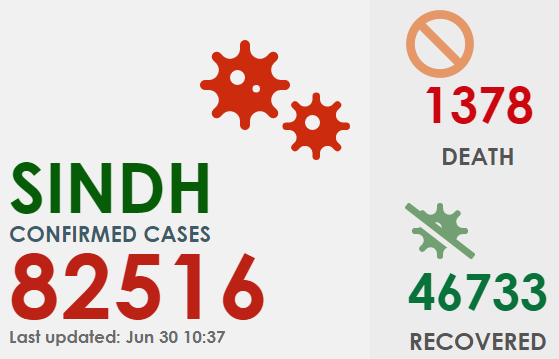
On the other hand, a website managed by the Sindh health department showed the overall COVID-19 death toll as 1,378, while the total infections remained 82,516 in Sindh. 

Of the 1,539 cases confirmed during the last 24 hours ending at 9 am on June 29, 689 (45%) were registered at Karachi, while remaining 850 (55%) were reported from the interior districts of Sindh, which passed the impression that number of testing had increased in the districts other than those of Karachi division. 

Hyderabad reported 93 new infections, followed by Ghotki (76), Sukkur (74), Mirpurkhas (34), Tando Allahyar (32), Jacobabad (28), Sanghar (23), Shaheed Benazirabad (23), Larkana (22), Kambar Shadakot (19), Shikarpur (19), Dadu (13), Umerkot (12), Badin (9), Naushero Feroze (9), Sujawal (6), Tando Mohammad Khan (5), Thatta (4), Kashmore (2), Kandhkot (1) and Matiari (1). 

The daily infection rate came as 18.8%, against 24% of June 28, with an overall case fatality rate of 1.7%. 

According to a report, the number of daily COVID-19 cases has decreased from 6,604, recorded on June 19, to 3,557, recorded on June 28, across the country, which indicated a reduction of 43% in 10 days.