Feedzilla

Tuesday, July 21, 2020

Pakistan starts manufacturing heavy cranes


By Masood Sattar Khan
(Pakistan News & Features Services)

Pakistan has started manufacturing heavy recovery cranes that hitherto were being imported after spending precious foreign exchange phenomenally. 

The Rescue 1122 vehicles are equipped with these recovery cranes. A fleet of these recovery cranes have already been manufactured for the Rescue 1122 of the Khyber Pakhtunkhwa government. 

"Army Engineering Corps deserves a lot of appreciation for manufacturing these sophisticated cranes. It will save the country millions of dollar,” a delighted Chaudhary Fawad, Federal Minister for Science and Technology, tweeted.

Coronavirus Update: Sindh fatalities cross 2,000

By Mukhtar Alam
(Pakistan News & Features Services)


Sindh, witnessing a relative dropping in its daily COVID-19 fatalities, reported its disease death tally surpassing 2,000 on July 20 when authorities in the government confirmed 26 new deaths during the last 24 hours, with 535 patients admitted in critical conditions at hospitals.

The Sindh Chief Minister, Syed Murad Ali Shah in his daily COVID-19 status statement, declared that the number of related fatalities reached 2019 during the last 24 hours ending on July 20 morning, with 546 new cases.

“In all 712 infected people are hospitalized, out of which 535 are in critical condition, including 75 those put-on ventilators,” he stated. 

According to official data, 613 patients have died of COVID-19 in July. The death tally was 1,406 on July 1, which rose to 1713 on July 10, 1,826 on July 13 and 1,922 on July 16. 

However, any district wise segregation of fatalities was not made available by the Sindh health department. 

Sindh registered 113,007 COVID-19 infections till July 19 with a case fatality rate of 1.76%, against Pakistan’s total 265,083 cases notified since the beginning of the outbreak with 5,599 deaths (CFR-- 2.11%).

“As of July 19, of the 53,555 currently active cases, 2,541 cases are hospitalized, out of which 1,552 (61.07%) are in critical condition. 51,014 COVID-19 positive cases are at designated isolation facilities or in-home isolation,” a report updated by an international health agency noted.

On July 20, Sindh’s new cases were reported at Karachi (179), Khairpur (29), Ghotki (21), Sukkur (18), Tando Mohammad Khan (17), Hyderbad (16), Sujwal (15), Jamshoro (15), Larkana (13), Jacobabad-13, Naushero Feroze (11), Umerkot (9), Matiari (9), Kashmore (8), Shikarpur (8), Mirpurkhas (7), Dadu (4), Thatta (4), Sanghar (3), Shaheed Benazirabad (1), and Badin (1), as per the Chief Minister’s statement.

An official report said that of the 295 intensive care unit beds allocated for COVID-19 patients in Karachi, 74 were occupied by patients who required ventilators while another 105 patients were off-ventilators.

On the other hand of the 91 ICU beds reserved for COVID-19 patients at hospitals in Hyderabad, Sukkur, Larkana and Shaheed Benazirabad, only 16 were occupied by off-ventilators patients.

A World Health Organization (WHO) Sindh sub-office report revealed that as of July 19, the infection attack rate was maximum in the Karachi division at 512 every 100,000 population, followed by 230 in Sukkur, 190 in Hyderabad, 190 in Ghotki, 132 in Larkana, 110 in Shikarpur, 109 Khaipur, 108 in Jamshoro and other districts.

MoU inked for 700 MW solar energy units


By Masood Sattar Khan
(Pakistan News & Features Services)

Pakistan has signed Memorandum of Understandings (MoUs) with a couple of Chinese companies for the purpose of generating 700 megawatts of solar energy. 

According to the Advisor on Trade Abdul Abdul Razzab Dawood, the MoUs were signed with Power China and FIEDM for generating 700 megawatts of solar energy to be used in M-3 Industrial City and Allama Iqbal industrial City. 

Speaking at the signing ceremony the Advisor said that Special Economic Zones and industrial growth in the country will be promoted through the CPEC projects. 

He announced that the government was making every effort to ensure uninterrupted provision of electricity for industries.

Monday, July 20, 2020

Jumbo author Mian Saeed passes away


By Abdul Qadir Qureshi
 (Pakistan News & Features Services)

Mian Mohammad Saeed, who was quietly serving the cause of Urdu literature for the past one decade, has passed away after protracted illness in his hometown Ahmed Pur East. 

The family sources announced his death on the website of bio-bibliography.com which he had launched in 2012 and took care of it until the end of his life. 

Mian Saeed was one of the two co-compilers of Jumbo Publishing’s famed title ‘Faiz Huay Hain Mar Kay Amar’ which was published in 2014. Prof Dr Nasim Fatima, a noted scholar and researcher, was the other compiler of the first-ever Urdu publication of Jumbo Media Group. 

Upon retirement from business, Mian Saeed displayed tremendous passion for research and literary pursuits. He was observed having spent days after days at the various libraries of Karachi to fuel his passion. 

The establishment of a website www.bio-bibliography.com was a labour of his love as he had put together invaluable information from different authentic sources to develop a worthy resource for the research enthusiasts.

He had also worked with great dedication, with Prof Dr Nasim Fatima, in the compilation of book on ‘Faiz Huay Hain Mar Kay Amar’ which was spread over more than 400 pages.

Quite a few books had earlier been published on Faiz Ahmed Faiz but ‘Faiz Huay Hain Mar Kay Amar’ stood out as a most useful publication as it was lauded by the literary pundits.

The management of Jumbo Media Group has condoled the death of Mian Mohammad Saeed, describing his passing away as a huge loss to the bibliography community.

Sunday, July 19, 2020

China's port city Tianjin houses beautiful mosque


By Masood Sattar Khan
(Pakistan News & Features Services)

Tianjin, one the China’s busiest port cities and close to Beijing, has a beautiful masque sprawling on 1970 meters with all modern facilities for worshippers. 

The famous Tianjin East Mosque is located in downtown at Ermalu Road in Nankai district. Tianjin is estimated to have around a Muslim population of 180,000. 

The mosque was built anew in 2008 when it was relocated to shift for more spacious space to facilitate the local Muslims. 

The new mosque is very beautiful with modern facilities thus the atmosphere becomes more comfortable for the worshippers. The walls of the main prayer hall are decorated with verses from Holy Quran.

China frenzy moviegoers’ wait end


By Masood Sattar Khan
(Pakistan News & Features Services) 

China's frenzy moviegoers, denied the pleasure of watching their favourite movies due to the COVID-19 pandemic, don’t have to wait further as cinema houses are scheduled for reopening on July 20. There was a big rush as box office pre-sales for the day have surpassed 256,000 yuan ($36,700) as of afternoon on July 19.

According to the Maoyan Pro app which observes real-time box office information, pre-sales for cinemas across the Chinese mainland had exceeded 256,000 Yuan as of 3:00 pm and was going up rapidly. 

According to the app, a cinema called Chengdu Eying 1958 Movie Palace in Southwest China's Sichuan Province championed with 12,000 Yuan in box office pre-sales on July 19, with 589 viewers having booked their tickets. 

Altogether 12 screenings have been scheduled at Eying 1958 cinema and the only film that will be shown is A First Farewell, a movie produced in Northwest China's Xinjiang Uyghur Autonomous Region that tells the story of a local Xinjiang boy getting along with his friends and mother.

The top 10 cinemas with the largest presale bookings were mainly located in southern China, such as Hangzhou, Shanghai, Guangzhou and eastern China's Jiangsu and Anhui provinces. 

The China Film Administration announced on July 16 that cinemas in low-risk areas will be allowed to reopen starting from July 20, while those in high-risk areas will still remain closed. 

In order to ensure safety of the moviegoers, cinemas that reopen must strictly implement epidemic-related safety measures such as wearing of face masks, limiting seating capacity for each showing (no more than 30 percent), reducing the number of films to half that of the pre-epidemic period and banning all food and beverages in theaters, according to the announcement. 

Moviegoers must occupy alternate seats with a space of at least one meter between one another. The policy also requires that intervals between showings will be extended, for thorough cleaning and disinfection in between.

Coronavirus Update: Interventional gaps in management of patients feared

By Mukhtar Alam
(Pakistan News & Features Services)


Amidst reports that daily COVID-19 infection number was on decline, any significant reduction in the number of critically ill patients at distinguished hospitals of Sindh, however, could not be witnessed till July 18 when the authorities in the government confirmed 71% critically ills, among the 744 hospital-patients, with registration of 880 new infections and 22 related fatalities during the last 24 hours.

As of July 17, there were 57,886 active cases in the country, out of which 2,690 cases were hospitalized, including 1,604 (59.62%) in critical condition, against Sindh’s 419 in critical condition. 

A study of relevant COVID-19 data revealed that Sindh had an average of 1,013 COVID-19 patients hospitalized daily during one-week period (July 12 to 18), out of which 51 per cent were reported critically ill. About 16% of the critically ill patients were put on ventilators daily. 

According to official reports, 72 patients occupying intensive care unit beds were put on ventilators in various hospitals of Karachi on July 18, against 77 using ventilators on July 17. 

As of July 17, the Karachi hospitals were having 116 patients on low flow oxygen and 188 on high flow oxygen while 96 were put on ventilators. Hyderabad had 11 on low flow oxygen, 10 on high flow oxygen while no one was put on ventilators. 

Keen observers noted that the presence of critically ill patients in high number reflected on the performance of hospitals. They feared that there are some interventional gaps in the management of COVID-19 patients, which finally led to an extraordinary increase in the number of patients requiring intensive care support and mechanical ventilation, many of whom failed to survive the diseases despite prolonged hospitalization. 

An official report said that the deceased COVID-19 patients belonged to all age groups, including females. Overall 1,502 patients have died at about 40 public and private hospitals across the province, so far. 

Of the patients admitted, 207 lost their lives at JPMC, 204 at DUHS Hospital, 201 at CHK, 158 at SIUT, 152 at Indus Hospital Korangi, 113 at AKUH, 86 at the Karachi Trauma Centre, 76 at ZU Hospital Clifton, 59 at Lyari General Hospital, 51 at ZU Hospital North Nazimabad, 33 at LUMHS Hospital Hyderabad, 23 at LNK Karachi, among others.

The Sindh Chief Minister, Syed Murad Ali Shah, in his daily statement related to COVID-19 status on July 18, informed that there were 18,761 infected people, who were receiving treatment at homes or isolation centres and hospitals across the province.

“We have 744 patients at hospitals, out of which 526 are in critical condition, while 72 required ventilators,” he added.

He further said that with 22 more COVID fatalities were reported during the last 24 hours ending July 18 morning, pushing the overall number of deceased persons to 1,974.

However, neither the Chief Minister nor the health department elaborated the fatalities in terms of their age and hospital or home and district they lived in.

According to the Chief Minister’s statement, Karachi reported 267 new cases, followed by Hyderabad (67), Khairpur (42), Sanghar (37), Sukkur (31), Shaheed Benazirabad (28), Mirpurkhas (27), Sujawal (22), Ghotki (21), Naushero Feroze (20), Dadu (18), Badin (15), Kambar Shahdadkot (13), Kashmore (13), Tando Allahyar (13), Larkana (12), Shikarpur (11), Jacobabad (7), Matiari (7), Thatta (7), Jamshoro (6), Tando Mohammad Khan (6) and Umerkot (2).

On July 17, all the COVID-19 testing laboratories, except one private and three public sector laboratories performed. Collectively they examined 9,270 samples, out of which 1,182 were found positive, including 880 new confirmed cases. The percentage of new cases among the samples came as nine.

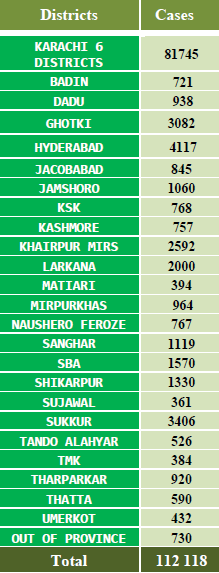
Sindh has reported a total 112,118 cases so far, while 91,383 of them have recovered from the disease.

Focus on agriculture, industrial development in CPEC 2nd phase


By Masood Sattar Khan
(Pakistan News & Features Services)

The second phase of the China Pakistan Economic Corridor (CPEC) will focus development of agriculture and setting-up industrial zones. 

The Federal Minister of Science and Technology, Fawad Chaudhry, in an interview on July 18, disclosed that energy and infrastructure development projects amounting to US$46 billion were undertaken in the first phase of the CPEC. 

Giving breakup of these invested amounts, Fawad Chaudhry pointed out an amount of $34 to 35 billion was spent in energy projects and remaining amount on construction of highways. 

Now the second phase of CPEC, being taken up under which Special Economic Zones will be set up around the infrastructure built under the first phase where factories would be established and finished goods will be exported. 

"The government has added agriculture in the CPEC second phase. I request Chinese companies to come forward and make investment along with local partners in Pakistan,” he emphasized. 

He assured whatever facilities the Chinese investors are availing in their own county, the same Pakistan will be provided.

China supports Afghanistan’s inclusion in CPEC


By Masood Sattar Khan
(Pakistan News & Features Services) 

China supports extension of the China-Pakistan Economic Corridor (CPEC) to Afghanistan so that the Afghan people can benefit from the Belt and Road Initiative (BRI).

This was disclosed by the Chinese Foreign Ministry’s spokesperson Hua Chunying a regular media briefing in Beijing. 

“China appreciates the resumption of trade between Pakistan and Afghanistan and ensure to play a constructive role to promote economic development and integration between two countries,” she remarked. 

Hua Chunying pointed out that Gwadar and other CPEC projects have played a significant role in regional integration. 

She mentioned that Pakistan has opened five key routes with Afghanistan for bilateral and transit trade over the past weeks to help war-ravaged Afghanistan boost trade. Pakistan, it may be recalled, had closed all trade routes with Afghanistan in March due to the COVID-19 outbreak.

CPEC brings employment opportunities for locals in Gwadar


By Masood Sattar Khan
(Pakistan News & Features Services)

The working classes, particularly labourers, living in Balochistan, who in the past happened to earn bread and butter for their families in other provinces, are now enjoying the luxury of jobs in their own province thanks to the projects initiated under the China Pakistan Economic Corridor (CPEC). 

According to the available details, as many as 280 or 94 percent locals persons were working at the Gwadar port alone, while on Gwadar bay Eastway there are 697 or 98 percent local people engaged. 

The CPEC projects have been recognized as the game-changer for Pakistan economy and the generation of jobs for locals was one of its major benefits.