Feedzilla

Thursday, July 23, 2020

Coronavirus Update: Infections double overnight in Karachi

By Mukhtar Alam
(Pakistan News & Features Services)


After witnessing a gradual decrease in its new COVID-19 infections for a week, Karachi reported a 120% increase in the number of daily new cases on July 22 when authorities in the government confirmed 1,109 new cases across the province during the last 24 hours, with 19 more related deaths.

The megapolis has reported an average about 400 new coronavirus cases daily since July 16. It registered 417 new cases on July 16, which increased to 477 on July 17 but gradually declined up to 179 on July 20. The infections increased to 324 on July 21.

The Sindh Chief Minister, Syed Murad Ali Shah, in his daily COVID-19 situation statement on July 22, disclosed that Karachi registered 714 new cases during the last 24 hours.

He shared that with the confirmation of 1,109 new cases the overall infection tally rose to 115,213 on July 22 for the province. Sindh’s new case reporting percentage came as 11%, against the overall provincial rate of infection of 18%.

According to the COVID-19 data, as narrated by the Chief Minister, there were 16,927 active patients, including 16,165 at homes, 61 at the isolation centres.

As many as 701 patients were admitted at hospitals, with 495 in critical condition, while 72 were on ventilators.

A total of 96,226 patients recovered across the province so far, including 1,929 who recovered from the diseases on July 22. With the new COVID-19 related fatalities, the overall number of people having lost their lives in the province came as 2,060 (CFR=2%).

However, no detail about the hospitals and districts of the deceased persons was available either from the Chief Minister or the Sindh health department.

In addition to Karachi, the districts where new cases were confirmed during the last 24 hours ending July 22 morning included Hyderabad (95), Tando Allahyar (26), Thatta (26), Sukkur (25), Matiari (23), Badin (21), Jacobabad (15), Jamshoro (14), Larkana (11), Sujawal (13), Shikarpur (11), Ghotki (9), Umerkot (9), Kambar Shahdadkot (8), Tando Mohammad Khan (4), Tharparkar (3), Shaheed Benazirabad (2), Khairpur (2) and Mirpurkhas (1).

The male-female ratio of the infected persons in the province was reported as 70.6% and 29.4%.

Keen observers felt that the overnight doubling of new infections was nothing surprising as the province was not yet out of the epidemic. The more they will go for sampling the suspected cases the more they will get the COVID-19 infections, it was reckoned.

According to an official report, as of July 21, as many as 6,676 samples were tested at COVID-19 laboratories across Sindh, against a collective capacity of 14,850 tests, while 846, including 551 new cases were found positive.

The report further said that till July 21, one patient died at isolation centre, while 1,544 at hospitals across the province. It was further learnt that of the 375 ICU beds at Karachi’s COVID-19 hospitals 71 were occupied by on-ventilator patients, while 107 were having off-ventilator patients on July 21.

 According to another report, overall 40 deaths occurred across the country on July 20, including four at-home deaths which were reported from Sindh. It was estimated that about 500 COVID-19 patients died at home or on their way to hospitals in Sindh so far.

Yet another relevant data revealed that in all 518 COVID-19 patients died at homes during a period from May 9 to July 21 across the country, compared to 4,493 deaths taking place at hospitals.

Shehron Mein Shehr Karachi celebrates City of Lights befittingly

By Abdul Qadir Qureshi
(Pakistan News & Features Services)

Describing her relationship with Karachi as ‘ancient’ as the city itself, Prof Dr Nasreen Aslam Shah, an eminent educationist, has done a wonderful job by bringing out a voluminous book ‘Shehron Mein Shehr Karachi’ which celebrates the City of Lights in a befitting manner. 

The hardbound book, spread over more than 500 pages, is an incredibly worthy effort, undertaken by Prof Dr Nasreen Aslam Shah, serving as the Dean of Faculty of Arts and Social Sciences at the University of Karachi, besides being the Director of the Centre of Excellence for Women’s Studies and the Acting Director of the Area Study Centre for Europe. Her forte, over the years, has been social work. 

“This book is an expression of my affection with Karachi and it’s a gift package for those who desire to learn about it. I have tried my best to put together the knowledge about every conceivable subject so that the read could get complete information about the metropolis in a single volume,” the learned professor remarked in a brief chat with PNFS on July 22. 

Prof Dr Nasreen Aslam Shah disclosed having consulted innumerable publications about the city, including the various editions of Jumbo Karachi Guide, for the purpose of gathering and compiling authentic data for her book. 

“Being associated with the field of education and research, I have included detailed information about the various areas of Karachi. Obviously it’s practically not possible to feature each and every aspect of this huge city but I have tried my level best to incorporate maximum possible information in it,” she added. 

‘Shehron Mein Shehr Karachi’ is indeed any researcher’s dream because it contains so much information about the city, including its history, geography and demography, which might not be possible to acquire from any other single publication. 

Prof Dr Nasreen Aslam Shah deserves to be complimented and recognized for having produced such an informative book which should be a part of every library and archival record in the country and abroad.

Chinese satellite images helpful in controlling locust plague


By Masood Sattar Khan
(Pakistan News & Features Services) 

The satellite images and meteorological data provided by China’s meteorological satellites can be useful to monitor Pakistan’s desert locusts thus preempted steps can greatly help crops from severe damage.

An official of China Meteorological Administration (CMA) disclosed, on July 22, having released special reports based on remote sensing data of locust attacks in Pakistan. 

“China’s Fengyun series satellites can generate information for analysis of locust-affected areas by monitoring rainfall, soil moisture and land surface temperature (LST) changes taking place in African and South Asian countries,” the CMA expert noted. 

He explained that hotter and wetter climate added more multiplication of locusts' population. The studies have also linked wind direction, speed, and other weather parameters to the migration of locusts. 

According to an update issued by the Food and Agriculture Organisation (FAO) of the United Nations (UN), the summer breeding of desert locust swarms has commenced in Pakistan’s Tharparkar, Nara and Cholistan deserts where hatching and band formation may increase later this month.

Wednesday, July 22, 2020

Pakistan’s university students teach globally


By Abdul Qadir Qureshi
(Pakistan News & Features Services)

Over 1,250 high school students from over a hundred cities across Pakistan, Saudi Arabia, the United States, the United Kingdom and the United Arab Emirates took part in a weeklong series of virtual, medical research courses organised by Aga Khan University’s Student Research Forum, SRF. 

The coronavirus pandemic has disrupted high school education around the world and has given teenage students the time and opportunity to enhance their skills in a variety of areas such as research and academic writing. 

For many participants, this was their first chance to gain an insight into how to conduct research that generates knowledge in novel areas of medicine and helps physicians assess the value of different types of treatment. 

"The world of research can be intimidating to many young students. Cost represents another barrier as online courses on research skills have high registration and certification charges. Through this course, we wanted to help our younger colleagues add another string to their bow and empower them to pursue their passion for research,” Ali Aahil Noorali, a final year student at AKU’s Medical College, and SRF president, observed. 

The free of cost, introductory sessions witnessed students alongside faculty from AKU’s Medical College explain the research process, analytical methods as well as key writing and referencing techniques to younger students. 

"Research is just like an adventure with so many unknowns to discover. Through this course, which is one of the first for pre-university students, we wanted to give more young people the chance to experience the thrill of conducting their own research experiments and the wonderful surprise that comes when you stumble upon an unexpected finding," Maha Inam, a third year student at AKU’s Medical College and SRF’s director of workshops, added. 

The workshop followed a similar series of free of charge, open-to-all introductory research courses aimed at medical university students in June 2020 that was attended by over 3,500 participants from over 30 cities in Pakistan. 

"Clinical medicine and clinical research have a symbiotic relationship. The more you research, the better your clinical practice and the more observations you make during your practice, the better your research. At the end of the day, medicine is a science and not just a profession and that’s why we want to help all students develop their research skills," Asma Merchant, a fourth year student at AKU’s Medical College and SRF’s vice president, " stated. 

The workshops were organised over Zoom livestream in collaboration with AKU’s Office of Student Experience in Pakistan.

Sister Ruth Lewis dies of COVID-19


By Mukhtar Alam
(Pakistan News & Features Services)

Sister Ruth Lewis, founding member of Darul Sakoon, a centre for physically challenged people in Karachi, lost her life to COVID-19 at a private hospital on July 20. She had tested positive for coronavirus on July 8. She was 77. 

People from different walks of life have paid glowing tribute to Sister Ruth, hoping that her example and spirit to serve humanity would be sustained. 

She was known to be looking after special children with utmost dedication for more than half a century. 

Syed Qasim Naveed Qamar, Special Assistant to Sindh Chief Minister on Department of Empowerment of Persons with Disabilities Sindh, expressed deep sorrow over the death, saying that the lady was had selflessly served the helpless people of the society and her services would be remembered for a long time.

Coronavirus Update: Sindh ahead other provinces in deaths, infection

By Mukhtar Alam
(Pakistan News & Features Services)


Sindh, in terms of COVID-19 fatalities reported during the month in progress, stood ahead of other three provinces on July 21 when authorities in the country recorded 551 new infections, with 22 related deaths during the last 24 hours.

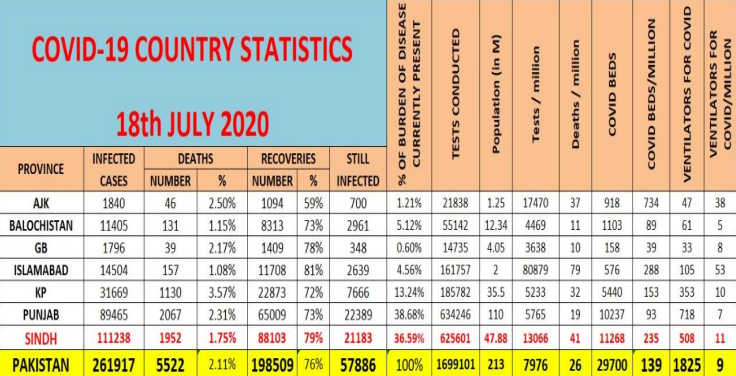
According to official data, Sindh had in all 664 COVID-19 deaths from July 1 to 21 in its population of 47.88 million, as such its deaths per million came as 14, against six of KPK, three of Punjab, and one of Balochistan for the same period. 

Pakistan’s death/per million remained six during July. 

The Sindh Chief Minister, Syed Murad Ali Shah, in his daily COVID-19 statement on July 21, remarked that 6,676 samples were tested during the last 24 hours across the province, out of which 551 were detected positive for the virus. Sindh has tested 656,593 samples so far, with a positivity rate of 17%. 

According to the Chief Minister, with 22 more deaths of the coronavirus infected patients, the overall tally of COVID fatalities has reached to 2,041.

However, neither he nor the provincial health department gave any district-wise breakdown of the newly occurred deaths.

As per a federal government dashboard, Sindh had witnessed the maximum 14,027 patients having recovered from COVID-19 on July 17, which gradually decreased to 1,365 on July 21.

During the last 24 hours, Karachi registered 324 new cases, followed by Hyderabad (36), Khairpur (20), Shaheed Benazirabad (20), Shikarpur (17), Sukkur (12), Ghotki (10), Larkana (9), Tando Mohammad Khan (9), Kambar Shahdadkot (6), Jamshoro (3), Thatta (3), Dadu (2), Jacobabad (2), Tando Allahyar (2), Sanghar (2), Tharparkar (2), Badin (1), Naushero Feroze (1) and Mirpurkhas (1).

Meanwhile, addressing a press conference on July 21, the spokesperson of Sindh Government, Barrister Murtaza Wahab, observed that the spread of COVID-19 was being controlled with the cooperation of the people of Sindh.

“The Sindh government's strategy to curb the spread of corona has been successful,” he added while presenting the statistics of people infected with the corona virus.

According to him until July 21, the number of cases of coronavirus was about 113,000 while the number in other provinces was very low.

He added that 450,000 tests have been done in Sindh while Punjab which has many times more population than Sindh has undergone about four lakh corona virus tests.

“Sindh also has a high recovery rate among patients infected with the corona virus. Eighty two per cent of patients have recovered in Sindh, while the number is much lower in Punjab and other provinces,” he pointed out.

He further said that the death rate of patients from COVID-19 was also lower than all other provinces in Sindh.

“The statistics show that the Sindh government's strategy regarding coronavirus has been successful,” he reckoned.

Two billion mangroves sapling planted in Sindh coastal areas


By Masood Sattar Khan
(Pakistan News & Features Services)

Over two billion saplings of mangroves have been planted in coastal belts of Sindh. 

For the first time the data of plantation is being computerized in the province, the Sindh Minister for Forest and Information, Syed Nasir Hussain Shah, disclosed while talking to various delegations here July 21. 

He pointed out through this plan an income of Rupees 10 billion would be generated that would be spent on the welfare of the masses.

Tuesday, July 21, 2020

Pakistan starts manufacturing heavy cranes


By Masood Sattar Khan
(Pakistan News & Features Services)

Pakistan has started manufacturing heavy recovery cranes that hitherto were being imported after spending precious foreign exchange phenomenally. 

The Rescue 1122 vehicles are equipped with these recovery cranes. A fleet of these recovery cranes have already been manufactured for the Rescue 1122 of the Khyber Pakhtunkhwa government. 

"Army Engineering Corps deserves a lot of appreciation for manufacturing these sophisticated cranes. It will save the country millions of dollar,” a delighted Chaudhary Fawad, Federal Minister for Science and Technology, tweeted.

Coronavirus Update: Sindh fatalities cross 2,000

By Mukhtar Alam
(Pakistan News & Features Services)


Sindh, witnessing a relative dropping in its daily COVID-19 fatalities, reported its disease death tally surpassing 2,000 on July 20 when authorities in the government confirmed 26 new deaths during the last 24 hours, with 535 patients admitted in critical conditions at hospitals.

The Sindh Chief Minister, Syed Murad Ali Shah in his daily COVID-19 status statement, declared that the number of related fatalities reached 2019 during the last 24 hours ending on July 20 morning, with 546 new cases.

“In all 712 infected people are hospitalized, out of which 535 are in critical condition, including 75 those put-on ventilators,” he stated. 

According to official data, 613 patients have died of COVID-19 in July. The death tally was 1,406 on July 1, which rose to 1713 on July 10, 1,826 on July 13 and 1,922 on July 16. 

However, any district wise segregation of fatalities was not made available by the Sindh health department. 

Sindh registered 113,007 COVID-19 infections till July 19 with a case fatality rate of 1.76%, against Pakistan’s total 265,083 cases notified since the beginning of the outbreak with 5,599 deaths (CFR-- 2.11%).

“As of July 19, of the 53,555 currently active cases, 2,541 cases are hospitalized, out of which 1,552 (61.07%) are in critical condition. 51,014 COVID-19 positive cases are at designated isolation facilities or in-home isolation,” a report updated by an international health agency noted.

On July 20, Sindh’s new cases were reported at Karachi (179), Khairpur (29), Ghotki (21), Sukkur (18), Tando Mohammad Khan (17), Hyderbad (16), Sujwal (15), Jamshoro (15), Larkana (13), Jacobabad-13, Naushero Feroze (11), Umerkot (9), Matiari (9), Kashmore (8), Shikarpur (8), Mirpurkhas (7), Dadu (4), Thatta (4), Sanghar (3), Shaheed Benazirabad (1), and Badin (1), as per the Chief Minister’s statement.

An official report said that of the 295 intensive care unit beds allocated for COVID-19 patients in Karachi, 74 were occupied by patients who required ventilators while another 105 patients were off-ventilators.

On the other hand of the 91 ICU beds reserved for COVID-19 patients at hospitals in Hyderabad, Sukkur, Larkana and Shaheed Benazirabad, only 16 were occupied by off-ventilators patients.

A World Health Organization (WHO) Sindh sub-office report revealed that as of July 19, the infection attack rate was maximum in the Karachi division at 512 every 100,000 population, followed by 230 in Sukkur, 190 in Hyderabad, 190 in Ghotki, 132 in Larkana, 110 in Shikarpur, 109 Khaipur, 108 in Jamshoro and other districts.

MoU inked for 700 MW solar energy units


By Masood Sattar Khan
(Pakistan News & Features Services)

Pakistan has signed Memorandum of Understandings (MoUs) with a couple of Chinese companies for the purpose of generating 700 megawatts of solar energy. 

According to the Advisor on Trade Abdul Abdul Razzab Dawood, the MoUs were signed with Power China and FIEDM for generating 700 megawatts of solar energy to be used in M-3 Industrial City and Allama Iqbal industrial City. 

Speaking at the signing ceremony the Advisor said that Special Economic Zones and industrial growth in the country will be promoted through the CPEC projects. 

He announced that the government was making every effort to ensure uninterrupted provision of electricity for industries.