Feedzilla

Tuesday, September 8, 2020

China unwilling to recognize Arunachal Pradesh


By Masood Sattar Khan
(Pakistan News & Features Services)

China has asserted that they had never recognized Arunachal Pradesh which they considered to be established illegally by India on the Chinese territory.

“We have never recognized the so-called Arunachal Pradesh that’s illegally established on the Chinese territory,” the country’s Foreign Ministry spokesperson, Zhao Lijian, declared during his regular briefing September 7. 

He stated that China’s position on the eastern section of the China and India boundary and China’s Southern Tibet was consistent and clear. 

Responding to a question about five civilians who went missing from Arunachal Pradesh a few days ago, he said, “Regarding the specifics, you mentioned I am not aware of it now.” 

The Chinese and Indian soldiers recently engaged in the most serious border clashes since they fought a war in 1962, leaving as many as 20 Indian soldiers dead during the fight. 

The border covers nearly 3,500 kilometers (2,175 miles) of frontier that the two countries call the Line of Actual Control and that stretches from Ladakh in the north to the Indian state of Sikkim in the northeast.

95% COVID-19 patients asymptomatic: Study


By Abdul Qadir Qureshi
(Pakistan News & Features Services)

More than 9 out of 10 people infected with coronavirus (COVID-19) experience have had no symptoms of the disease, a new study, carried out by the Aga Khan University (AKU) researchers, revealed.

Karachi has the most COVID-19 cases in Pakistan and the study saw AKU faculty investigate COVID-19’s prevalence in parts of the city with high and low rates of transmission in the community in April and June 2020. 

They found out that 95 percent of those who tested positive for COVID-19 through blood tests, which register the presence of antibodies to fight the disease, reported feeling no symptoms of the illness such as a cough, fever or sore throat. In other words, they were asymptomatic. 

The proportion of asymptomatic cases in Pakistan is much higher than the developed world. Since asymptomatic people do not seek hospital treatment this may help explain why Pakistan’s hospitals have not been under the same strain as in Spain and the UK, according to researchers. 

The results also indicated that children and adolescents are just as likely to catch the disease as adults. Men and women face the same risk of being infected. 

The study also confirmed a sharp rise in COVID-19 cases between April and June this year from 0.2 per cent to 8.7 per cent in low community transmission areas such as Ibrahim Hyderi, and from 0.4 per cent to 15.1 percent in high community transmission sites like Safoora Goth, Faisal Cantonment, Pehlwan Goth and Dalmia/Shanti Nagar.

These results were in line with the federal government’s national seroprevalence study where antibody testing found that overall, 11 percent of Pakistanis had contracted the disease.

“The sharp increase in antibody levels in an area with low reported cases indicates that the virus continues to spread unchecked in populations where testing rates are sub-optimal,” Dr Imran Nisar, an assistant professor at AKU and co-investigator on the study, remarked.

Over 2,000 participants were engaged in the first two phases of the study. The researchers are currently undertaking a third serosurvey and plan to do a fourth in September 2020. These surveys will show the impact of easing lockdowns around Eid-ul-Azha and the impact of the Muharram processions on the coronavirus transmission rate in communities.

"Antibody testing or seroprevalence provides a true picture of the burden of COVID-19 as they capture asymptomatic cases who represent silent carriers of the disease. Understanding how, when and in what types of settings, COVID-19 spreads is critical to developing effective public health and infection prevention measures to break chains of transmission,” Dr Fyezah Jehan, an associate professor at AKU and co-investigator on the study, explained.

AKU’s Dr Nadia Ansari and Dr Mashal Amin as well as US-based international collaborators Dr Bailey Fosdick and Dr Daniel Barremore also contributed to the study.

Educational institutions allowed reopening in phases from September 15


By Mukhtar Alam
(Pakistan News & Features Services)

The Sindh Minister for Education, Saeed Ghani, has declared that educational institutions in the province will reopen from September 15 to 30 in phases, while observing the relevant Standard Operating Procedures (SOPs).

In accordance with the federal government’s decision, the institutions will be allowed to start conducting teaching for classes IX and above, including the higher seats of learning, from September 15 while classes VI to VIII will resume from September 22 and pre-primary and primary classes will be getting underway from September 30. 

Meanwhile, the All Private Schools Management Association Sindh (APSMAS), has welcomed the decision of the government and assured strict compliance of the SOPs in conducting classes and all other activities at the campus. 

The APSMAS Chairman, Syed Tariq Shah, in his video, released soon after the government decision earlier in the day, agreed to implement all the SOPs in letter and spirit. 

It may be recalled that the majority of the schools throughout the country have been closed since February when coronavirus (COVID-19) was confirmed to have reached Pakistan while the universities and all other educational institutions have been kept shut on government orders since the middle of March.

Monday, September 7, 2020

JPMC to setup free tomotherapy machine


By Masood Sattar Khan
(Pakistan News & Features Services)

The Jinnah Postgraduate Medical Centre (JPMC), Karachi, is in process of setting up what is reported to be the first state of the art and world class tomotherapy equipment. 

The tomotherapy machine has the unique feature that provides high precision treatment of cancer radiation, especially for breast cancer as well as cancer treatment among kids. It can even hit the tumor even from a 360 degree angle.

The JPMC, located in the cantonment area of Karachi, caters to a colossal number of patients on a daily basis and its emergency services are known to be the most efficient in the metropolis.

Sunday, September 6, 2020

Coronavirus Update: No death in Sindh after almost six months

By Mukhtar Alam
(Pakistan News & Features Services)


Sindh, already overwhelmed by the officialdoms claiming COVID-19 has lost its intensity in the country, reported no related death on September 5 when the authorities in Karachi confirmed detection of 230 more infections during the last 24 hours across the province.

Moreover, the gap between the infected ones and those who got recovered from the diseases was also shrunk significantly in Sindh. 

As many as 2,152 more patients were cleared by the healthcare providers on September 5 after completion of their COVID-19 treatment, taking the tally of the cured people to 126,164 (97%), out of 130,483 positive cases, for the province, while about 2% lost their lives. 

Sindh had reported its first COVID-19 fatality on March 19 when a 77-year-old patient, a cancer survivor and hypertension case also, with a total of 217 existing cases on the day. The second such death had occurred on March 28 and since then the province registered one or more deaths every day till September 5. 

The province, according to official data, updated on September 4, registered a maximum of 904 COVID-19 deaths in June, while the tally was 817 for July, 385 for May, 186 for August, 109 for April, 13 for September and eight for March. The highest one-day tally of deaths was witnessed in Sindh on June 28, with 74 deaths. Earlier, 48 and 49 deaths had occurred on June 17 and June 18 respectively. 

The Sindh Chief Minister, Syed Murad Ali Shah, in a message tweeted on September 5 that almost after six very difficult months they had no COVID-19 death in Sindh.

Resuming his statements after a gap of few days, he disclosed that there were 1,897 active COVID-19 patients across the province, including 1,578 at homes, six in isolation centres and 313 at the various hospitals, adding that as many as 141 were in the critical phase, while 16 were put of ventilators, as of September 5.

He urged people not to forget wearing a mask and keep themselves and their families safe.

Keen observers feared that the sighs of contentment were not going to be permanent in the given condition. The number of daily infection was still higher in Sindh, on the other hand the designated hospitals have not been able to check the cases turning critical and seeking ventilator intervention, the last hope for them in the intensive care units, they remarked.

In all 9,738 samples were tested for COVID-19 during the last 24 hours, with a positivity rate of 2.36%. Karachi reported 120 (52%) new cases, followed by Mirpurkhas (14), Hyderabad (8), Badin (7), Kambar Shadadkot (5), Shaheed Benazirabad (5), Dadu (4), Larkana (3), Naushero Feroze (3), Shikarpur (3), Umerkot (3), Jamshoro (2), Khairpur (2), Sukkur (2), Thatta (2), Ghotki (01) and Jacobabad (01).

Deeper agri sector cooperation sought with China


By Masood Sattar Khan
(Pakistan News & Features Services)

The Chinese Ambassador to Pakistan, Yao Jing, called on Foreign Minister, Shah Mahmood Qureshi, at Islamabad in which the latter called for deeper cooperation in the agriculture sector for the country's food industry.

"Agriculture plays an important role in Pakistan's economy. It is also a big source of job opportunities for the labour class,” Pakistan’s Foreign Minister pointed out. 

He stressed the need for cooperation from China for paving the way for bringing about the green revolution in Pakistan. 

Shah Mahmood recalled that China had brought about a revolution in the agriculture sector that greatly helped improve its GDP, adding that it’s very important for Pakistan to benefit from the Chinese experience. 

The Chinese Ambassador assured that his country was keen in setting up in cooperation with the research centres for prevention of diseases in plants and FMD zones.

Edhi Foundation introduces qualified technicians on board ambulances


By Masood Sattar Khan
(Pakistan News & Features Services)

Edhi Foundation, the pioneer of introducing ambulance service all over Pakistan, took another important initiative by deploying qualified medical technicians in their ambulances that could provide emergency first aid to patients, particularly those suffering from heart stroke. 

Before deployment, these technicians have completed an 18-month training course at the Edhi Centre on how to cope with a patient emergency. 

Over 60 technicians, including women, were imparted training on how to inject drip, CPR and catering heart patients while shifting to hospitals. 

Faisal Edhi revealed that these training would further be modified as per modern days requirements and the paid technicians got training as an approved course from an Ireland institute.

Saturday, September 5, 2020

Indian, Chinese ministers set to meet in Moscow


By Masood Sattar Khan
(Pakistan News & Features Services)

In an apparent effort to cool down tension on Line of Actual Control, the defence ministers of India and China are expected to hold talks in Moscow on later September 4, according to reports coming from New Delhi quoting government officials. 

This will be the first highest level face-to-face political contact since tensions flared along their disputed mountain border in May. 

The Indian Defence Minister, Rajnath Singh, was given clearance to meet his Chinese counterpart, Wei Fenghe, in Moscow, where both of them were attending a Shanghai Cooperation Organization (SCO) meeting, the report added.

Coronavirus Update: Sindh leads in infection, death

By Mukhtar Alam
(Pakistan News & Features Services)


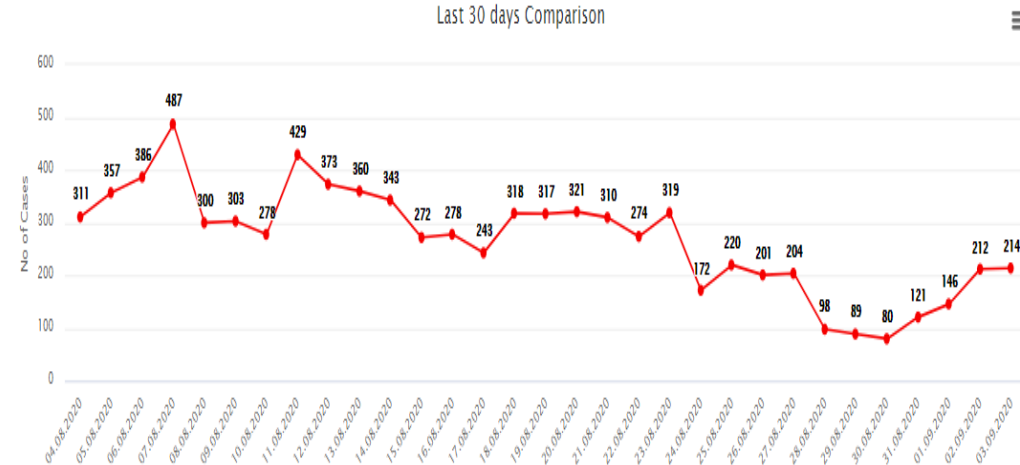
As many as five COVID-19 patients lost their lives during the last 24 hours, against seven deaths across the country, while 214 new cases were detected across the province, taking the overall tally of infection to 130,041 for the province on September 3.

According to national COVID-19 dashboard, Sindh’s rate of daily infection remained 2.62 % on morning of September 3, against Pakistan’s overall daily rate of 2.14%. 

The provincial government did not release any new data for the media on September 3, while the dashboard showed the overall death tally in the case of province as 2,420. 

With 202 new recoveries from the diseases, the number of patients having recovered was mentioned as 123,807 for Sindh. In all 8,155 new tests were conducted till September 3 morning, while there were 3,814 active COVID-19 patients. 

In the meantime, an official report revealed that 3,498 patients were in home-isolation, six were receiving treatment at the isolation centres, in addition to 310 at hospitals, including 140 hospitalized in critical condition, as of September 3.

As many as 21 patients were on ventilators. The persons, whose deaths were registered on September 3, were residents of Karachi Central (2), Karachi East (1), Karachi Korangi (1) and Karachi South (1).

It was further learnt that five persons who had died of COVID-19 on September 2 belonged to Karachi and the sixth one was from Hyderabad.

On September 3, new infections were reported from Karachi (119), Thatta (13), Badin (12), Dadu (4), Jamshoro (4), Mirpurkhas (4), Shikarpur (4), Tando Mohammad Khan (4), Naushero Feroze (4), Umerkot (3), Kambar Shahdadkot (3), Shaheed Benazirabad (2), Ghotki (2), Larkana (2), Hyderabad (2), Matiari (1), Sanghar (1), Khairpur (1), Sukkur (1), Tando Allahyar (1) and others.

Friday, September 4, 2020

Hustle, bustle return in Xinjiang


By Masood Sattar Khan
(Pakistan News & Features Services)

Hustle and bustle has returned in the Chinese province of Xinjiang as the authorities withdrew lockdown restrictions after a month. 

The main shopping centres and food streets were found packed with visitors buying and eating the famous Xinjiang foods. The mood is festive and people have smiles returning on their faces.

At the same time, industrial activities also resumed in the province with people engaged in their usual business.

Xinjiang region in mainland China was the last one from where lockdown has been withdrawn. The restrictions were clamped a month ago after detection of COVID-19 infection cases.